


Test Dispatch - Jul 2026 Newsletter
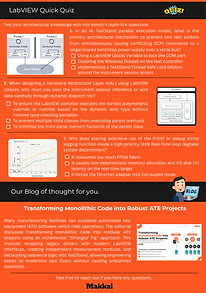
LabVIEW & TestStand Quick Quiz
Test your architectural knowledge with this month's rapid-fire engineering challenges.
1. In an NI TestStand parallel execution model, what is the primary architectural mechanism to prevent two test sockets from simultaneously issuing conflicting SCPI commands to a single shared benchtop power supply over a serial bus?
a) Using a LabVIEW Global Variable to lock the COM port
b) Disabling the Windows firewall on the test controller
c) Implementing a TestStand Thread-Safe Lock (Mutex) around the instrument session access
Answer c : A TestStand Lock step type (using a named Mutex) ensures that only one execution thread can acquire ownership of the shared instrument resource at a time, preventing command interleaving and communication corruption on shared buses.
2. When designing a Hardware Abstraction Layer (HAL) using LabVIEW classes, why must you pass the instrument session reference or wire data carefully through dynamic dispatch VIs?
a) To ensure the LabVIEW compiler executes the correct polymorphic override at runtime based on the dynamic wire type without runtime type-checking penalties
b) To prevent multiple child classes from overriding parent methods
c) To minimize the front panel memory footprint of the parent class
Answer a : Dynamic dispatch allows an interface or parent class to define a method signature while letting child classes (e.g., specific instrument drivers) implement specific behaviors. LabVIEW optimizes this dispatch to run efficiently while maintaining complete code decoupling.
3. Why does placing extensive use of the Printf or debug string logging function inside a high-priority 1kHz Real-Time loop degrade system determinism?
a) It consumes too much FPGA fabric
b) It causes non-deterministic memory allocation and OS disk I/O latency on the real-time target
c) It forces the Ethernet adapter into full-duplex mode
Answer b : Real-time loops (RTIs) running on NI Linux Real-Time or Phar Lap require fixed, predictable execution timing. String formatting and disk writes cause dynamic memory reallocation and unpredictable OS-level disk writing delays, destroying loop jitter margins.

Tech Deep Dive: Addressing Thread Contention in Multi-Site TestStand Sequences
When test developers shift from dual-site to quad-site execution in NI TestStand, they often encounter architectural challenges like CPU thread contention and race conditions. These arise from simultaneous access to shared calibration databases or instrument sessions. Default execution settings can worsen these issues by allowing steps to access the standard thread pool. Heavy logging or database writes may hinder measurement threads, causing unnecessary jitter and extended test times.
Makkal Pro-Tip: Dynamic - Link Library (.lvlibp) Version Locking
When updating production ATE stations using LabVIEW code modules within TestStand, avoid loading raw .vi dependencies directly from the disk to prevent accidental overrides, broken links, and slow load times. Pro Tip: Always package your driver layers and instrument abstractions into Packed Project Libraries (.lvlibp). This approach ensures that the lab-tested code runs smoothly on the factory floor and significantly reduces TestStand sequence initialization time. Discover Makkal's ATE Architecture Services.
Our Blog of Thought: Transforming Monolithic Code into Robust ATE Projects
Many manufacturing facilities use outdated automated test equipment (ATE) software, which risks operations. The editorial discusses transforming monolithic code into modular ATE projects using an incremental "Strangler Fig" approach. This involves wrapping legacy drivers with modern LabVIEW interfaces, creating independent measurement modules, and decoupling sequence logic into TestStand, allowing engineering teams to modernize test floors without causing unplanned downtime.