


Test Dispatch - Sep 2026 Newsletter
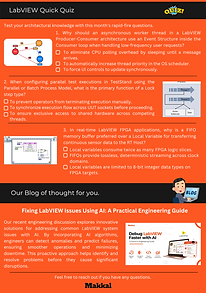
LabVIEW & TestStand Quick Quiz
Test your architectural knowledge with this month's rapid-fire questions.
1. Why should an asynchronous worker thread in a LabVIEW Producer-Consumer architecture use an Event Structure inside the Consumer loop when handling low-frequency user requests?
a) To eliminate CPU polling overhead by sleeping until a message arrives.
b) To automatically increase thread priority in the OS scheduler.
c)To force UI controls to update synchronously.
Answer: a (Eliminates CPU polling overhead) Using an Event Structure or blocking Dequeue node suspends execution until data is available, freeing system CPU cycles for measurement processing instead of consuming 100% thread utilization.
2. When configuring parallel test executions in TestStand using the Parallel or Batch Process Model, what is the primary function of a Lock step type?
a) To prevent operators from terminating execution manually.
b) To synchronize execution flow across UUT sockets before proceeding.
c) To ensure exclusive access to shared hardware across competing threads.
Answer: c (Exclusive hardware access) If multiple test sockets attempt to communicate with a shared instrument at the same time, VISA resource conflicts occur. The Lock step creates a critical section guaranteeing single-thread access.
3. In real-time LabVIEW FPGA applications, why is a FIFO memory buffer preferred over a Local Variable for transferring continuous sensor data to the RT Host?
a) Local variables consume twice as many FPGA logic slices.
b) FIFOs provide lossless, deterministic streaming across clock domains.
c) Local variables are limited to 8-bit integer data types on FPGA targets.
Answer: b (Lossless, deterministic streaming) Local variables are non-buffered and subject to race conditions. Direct Memory Access (DMA) FIFOs establish a dedicated hardware pipe between FPGA and RT Host memory, guaranteeing deterministic, lossless transmission.

Tech Deep Dive: Managing Crosstalk & Yield in Heterogeneous Integration
Themove to 2.5D/3D heterogeneous chiplet integration is reshaping ATE strategies. A Semiconductor Test Equipment Advances reports notes that concurrent testing (RF, digital, high-speed analog) on a single substrate is needed. High-density channel crosstalk threatens yields, prompting test teams to adopt high-bandwidth, low-noise front ends and automated electro-optical pin verification.
Makkal Pro-Tip: Asynchronous Limit Ingestion in TestStand
Don’t call synchronous fileI/O inside measurement loops for reading limit files. Instead, load parameter files into a shared memory buffer, like a TestStand Station Global or LabVIEW DVR, during PreSequence execution. This method ensures zero-latency access during production phases, optimizing performance and efficiency without interruptions caused by file access delays. Explore Solutions: Makkal's Custom ATE & PXI Integration Services
Our Blog Thought For You : Fixing LabVIEW Issues Using AI: A Practical Engineering Guide
Our recent engineering discussion explores innovative solutions for addressing common LabVIEW system issues with AI. By incorporating AI algorithms, engineers can detect anomalies and predict failures, ensuring smoother operations and minimizing downtime. This proactive approach helps identify and resolve problems before they cause significant disruptions.